
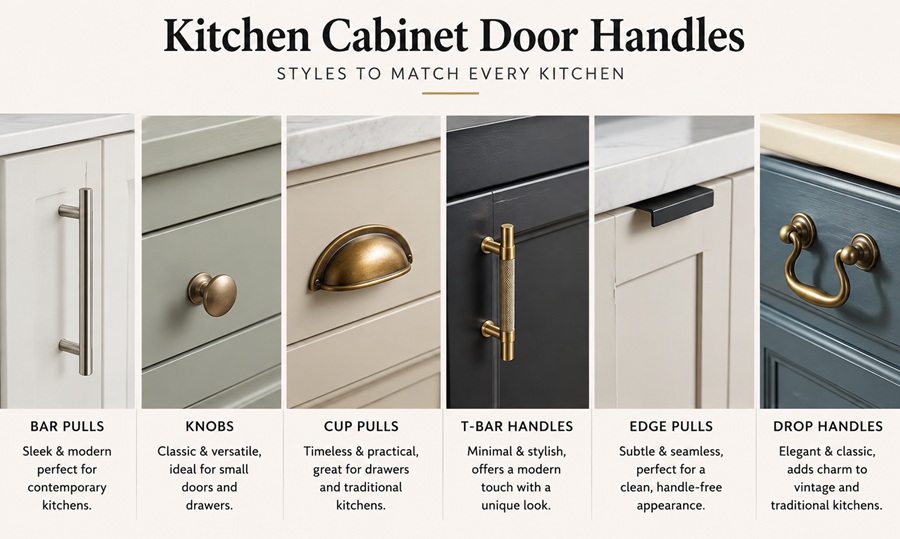

Choosing kitchen cabinet door handles comes down to three decisions: pull versus knob, finish, and placement. For most standard kitchens, bar pulls on drawers and knobs on doors give a balanced, easy-to-grip setup, in a finish that matches your faucet or lighting. Budget $3 to $25 per handle depending on material, with a full kitchen typically needing 20 to 40 pieces.
Here’s a checklist-first approach to getting this right the first time, since reordering hardware after installation is more of a hassle than it looks.
Quick Answer: What Handles Should You Get?
For most kitchens, a mixed approach works best: bar pulls (4 to 6 inches) on drawers for a secure grip, and either matching bar pulls or round knobs on cabinet doors. Match the finish to your faucet, cabinet hinges, or lighting fixtures so the metals feel coordinated rather than random. Budget-conscious kitchens can standardize on one simple pull style throughout to keep costs and installation time down.
Before You Shop: Checklist
- Measure your existing hole spacing if you’re replacing hardware (most pulls use a 3-inch or 4-inch “center-to-center” spacing)
- Count every door and drawer that needs hardware, plus a few spares in case of damage or future replacements
- Decide on a finish family: matte black, brushed nickel, brushed brass, or chrome are the most common in current kitchens
- Check your cabinet door thickness — thicker shaker-style doors may need longer screws than standard hardware kits include
- Set a per-piece budget before browsing, since hardware costs add up fast across a full kitchen
Detailed Guide: Types of Cabinet Handles
Knobs. Single-point round or square hardware, typically 1 to 1.5 inches. Best suited for cabinet doors rather than drawers, since a knob doesn’t give as secure a grip for pulling a heavy, loaded drawer.
Bar pulls. Straight horizontal handles ranging from 3 to 12+ inches. The most versatile option and standard for drawers, since the longer grip distributes pulling force better than a single knob.
Cup pulls. Curved, recessed handles that sit flush against the drawer front. Common in farmhouse and vintage-inspired kitchens.
Edge pulls. A slim, low-profile handle mounted along the top edge of a door or drawer, popular in modern minimalist kitchens where visible hardware is kept to a minimum.
Integrated or finger-pull channels. Built into the cabinet door itself with no separate hardware piece, used in fully handleless modern kitchen designs.
Cabinet Hardware Finishes and Sizing
Finish trends shift, but the most common options right now are matte black, brushed brass or gold, brushed nickel, and polished chrome. A safe rule: match your hardware finish to at least one other fixed element in the kitchen, like the faucet or pendant lighting, so the space doesn’t read as mismatched.
For sizing, drawer pulls generally look proportional at 30 to 40% of the drawer front’s width. A 24-inch-wide drawer front suits an 8 to 10-inch pull better than a tiny 3-inch handle, which can look undersized once installed.
How Do I Choose Kitchen Cabinet Handles?
- Measure existing hole spacing if replacing hardware, to avoid drilling new holes
- Match finish to existing fixtures — faucet, hinges, or lighting
- Count doors and drawers and order 2 to 3 extra pieces
- Choose pull length proportional to the drawer or door width
- Confirm screw length matches your cabinet door thickness
Tips for Getting It Right
Order one sample before buying the full set. Photos and screen colors can shift how a finish actually looks. A single sample handle held against your cabinets in daylight avoids a costly full-order mistake.
Don’t mix too many finishes. One or two coordinated metals throughout the kitchen looks intentional; three or more competing finishes can look cluttered rather than eclectic.
Budget-friendly swap: keep the knob holes, add a bar pull elsewhere. If you’re on a tight budget and existing knob holes don’t align with a longer bar pull, it’s often cheaper to keep knobs on doors and only upgrade to bar pulls on drawers, rather than re-drilling every cabinet.
Watch for weight on oversized pulls. Large decorative pulls look striking but can feel loose over time on thinner cabinet doors if not anchored properly. Solid cabinet stock handles this better than laminate over particleboard.
Common Mistakes to Avoid
A frequent error is buying hardware before confirming hole spacing, which leads to either patching old holes or settling for a size that doesn’t fit the intended look. Another is choosing a finish that clashes with existing hinges or the sink faucet, which becomes obvious the moment the new handles go in. Rushing the count is another one — running short mid-installation means a mismatched wait for a reorder.
Frequently Asked Questions
Should I use knobs or pulls on kitchen cabinets?
Pulls generally work better on drawers because they offer a fuller grip for heavier loads. Knobs suit cabinet doors well since a smaller grip point is enough for a lighter swing-open motion. Many kitchens use both.
What size cabinet pulls should I buy?
As a general guideline, choose a pull length equal to roughly 30 to 40% of the drawer or door width. Standard bar pulls range from 3 to 12 inches, with 5-inch and 8-inch sizes being the most commonly stocked.
How much does it cost to replace kitchen cabinet hardware?
Individual handles typically cost $3 to $25 depending on material and finish. A full kitchen with 25 to 35 pieces usually runs $150 to $600 for hardware alone, not including installation labor if hired out.
Can I install new cabinet handles myself?
Yes, in most cases. If hole spacing matches your existing hardware, it’s a straightforward drill-and-screw job. If hole spacing changes, you’ll need to fill and patch old holes, which is more involved but still manageable as a DIY project.