
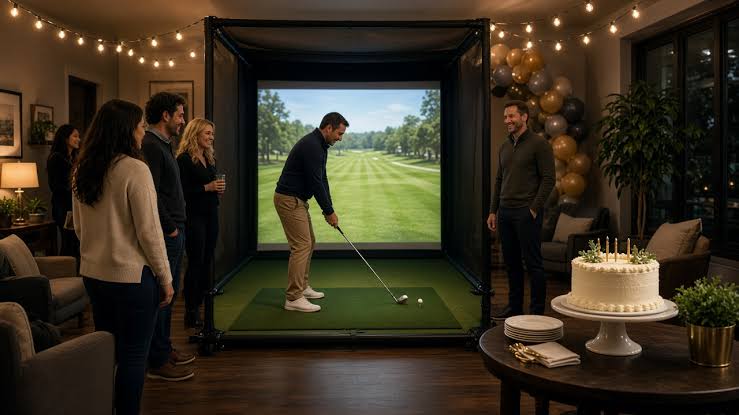

Every host knows the moment. The food is out, the music is fine, and the guests have split into the same little clusters they arrived in. Coworkers stand with coworkers and cousins with cousins. What breaks that pattern is usually something to do, something people can watch, try and laugh at with strangers. A golf swing, it turns out, does all of that remarkably well.
That is a big part of why simulator golf has spilled out of indoor lounges and into backyards, office courtyards and wedding receptions. Rental outfits such as On-the-go-golf.com bring a complete hitting bay to wherever the event is happening, which flips the usual plan of herding a group to a course or a booked venue. Nobody has to travel, nobody needs a tee time, and the game sits right next to the snacks.
The wider numbers explain the curiosity. The National Golf Foundation counted more than 48 million Americans swinging a club in 2025, with nearly 19 million of them playing only off course at ranges, simulators and entertainment venues. Its research also found that about half of simulator users had not played a round on an actual course in the previous year. So the screen works for the crowd you actually have, not the crowd of golfers you wish you had.
What Rolls Up Before the First Swing
Most mobile setups come down to a handful of parts working together.
- An enclosure, either a framed bay or an inflatable shell, that contains the ball and blocks stray light
- An impact screen thick enough to absorb full driver swings without tearing
- A short throw projector that paints the course onto that screen
- A launch monitor, the brain of the whole thing, which reads the ball and club at impact
- A hitting mat with surrounding turf, plus right and left handed clubs for guests who arrive empty handed
- Software loaded with real course recreations and party style games
The launch monitor deserves a closer look because it decides how believable the experience feels. Radar units track the ball over a longer flight and tend to suit setups with room behind the hitter. Camera based units photograph the ball in the first instants after impact and calculate spin and launch with impressive precision, which makes them popular in tighter bays.
Many operators assemble a full bay in about an hour, so it can be ready before guests arrive.
Does Your Space Pass the Swing Test?
This is where most planning goes sideways. A driver swing needs more room than people picture, both above the head and around the body. Indoors, a ceiling of roughly ten feet is a comfortable minimum for taller players, and the bay typically wants a width of twelve to fifteen feet so a backswing never flirts with a wall.
Outdoors, the questions change. The ground should be flat and firm, because a sloping lawn tilts the mat and throws off readings. A standard household outlet usually covers the power draw, though a long extension run is worth testing before the day. Bright afternoon sun can wash out a projected image, so shade, a covered patio or an evening start makes a visible difference.
Then there is the safety zone. Spectators naturally drift toward the action, and someone has to keep them out of the swing path and away from the hitter’s side. Good operators send a staff member largely for this reason.
One Screen and a Very Mixed Crowd
A simulator handles a mixed crowd well because each type of guest finds a different reason to step up.
The nervous beginner gets a soft landing. Software can shorten holes and switch to forgiving modes, and a topped shot on a screen draws laughter rather than the silent judgment of a real foursome waiting behind.
The competitor finds a scoreboard. Long drive and nearest to the pin contests turn a casual evening into a leaderboard, and few things fuel conversation like a quiet uncle suddenly sitting in first place.
The serious golfer finds data. Ball speed, launch angle, spin rate and carry distance appear after every swing, which turns the bay into a free practice session for the guest who keeps wondering what their seven iron really carries.
Kids find a video game they can play with their whole body.
And the host finds a focal point. A simulator anchors the crowd in one area, gives shy guests an easy opening line, and keeps the energy steady long after the food is gone.
Keeping the Line Moving All Evening
A full eighteen holes for four players can take well over an hour, which is wonderful in a private bay and painful at a party of sixty.
Short formats solve the problem. A nearest to the pin round takes about a minute per guest, so dozens of people can play within an hour. Long drive contests move just as quickly. For corporate events, a scramble across three or four signature holes gives teams a shared goal and a reason to cheer for each other. A running leaderboard with a small prize keeps guests drifting back for one more try.
Guest count shapes the choice. Big gatherings run best on short, repeatable games, while smaller groups can settle in and enjoy a proper round on a course they may never visit in person.
The Small Details That Decide the Day
Plenty of good events stumble on little things. Ball strikes against an impact screen make a satisfying thud that carries farther than expected, so a quick word with neighbors keeps everyone friendly. Breweries, hotels and wedding venues often have rules about outside vendors and insurance, and confirming those early prevents a scramble the week before. A rain plan matters for outdoor dates, whether that means a covered space, a garage or an enclosure built for light weather.
Timing deserves a thought as well. Summer weekends, graduation season and the December party rush fill calendars fast, and Saturdays often need booking weeks in advance.
Where the Party Leads Afterward
Something interesting happens after these events. The guest who swore they had never held a club asks where the nearest range is. The cousin who won the long drive contest starts looking up beginner lessons. The NGF has found that roughly two thirds of new golfers on real courses arrive with some off course experience behind them, so this pattern is no accident. A party simulator can quietly become the first chapter of someone’s golf life.
That may be the best case for inviting a screen to your next gathering. It entertains the crowd, it mixes strangers, and every so often it hands someone a game they will keep playing long after the music stops.