
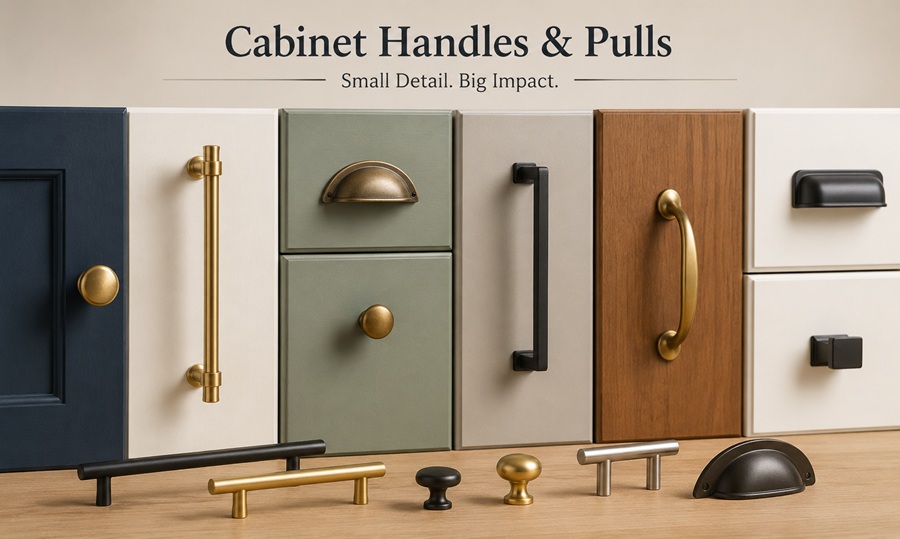

Cabinet handles and pulls are two different types of hardware, not interchangeable names for the same thing. A handle or knob is a single-point grip, usually round or square, while a pull is a longer bar-style handle mounted at two points. Pulls typically cost $5 to $30 each, knobs $3 to $20, with finish and material driving most of the price difference.
Several assumptions about cabinet hardware are common but not quite accurate. Here’s what’s actually true, based on how these fixtures are made and used.
Myth vs. Reality
Myth: Knobs are outdated. Reality: knobs remain standard on cabinet doors across nearly every kitchen style, from farmhouse to modern. What’s changed is finish and shape, not whether knobs are used at all.
Myth: All hardware fits any cabinet. Reality: hole spacing varies. A pull designed for 4-inch center-to-center spacing won’t align with holes drilled for a 3-inch pull, meaning a straight swap often requires either matching spacing exactly or patching and redrilling.
Myth: Bigger hardware always looks better. Reality: oversized pulls on small or thin cabinet doors can look disproportionate and, on lower-quality doors, add stress to the mounting point over time. Sizing should scale with the cabinet, not personal preference alone.
Myth: Hardware finish doesn’t need to match other fixtures. Reality: while mixed metals are a valid design choice, unplanned mismatches — where the faucet, hinges, and pulls are three unrelated finishes — tend to read as accidental rather than intentional.
Facts: What Actually Matters When Choosing Hardware
Sizing standards. Pulls are measured by the distance between mounting screws, commonly 3, 3.75, 4, 5, or 8 inches. Knobs are measured by diameter, typically 1 to 1.5 inches. Confirming this measurement before ordering prevents mismatched holes later.
Material durability. Solid zinc, brass, and stainless steel hold up to daily use significantly better than lightweight pot metal, which can loosen or corrode faster, especially in humid kitchens or bathrooms.
Cost ranges by finish. Chrome and standard nickel finishes tend to sit at the lower end of the price range. Brushed brass, matte black, and specialty finishes like oil-rubbed bronze usually cost more due to the finishing process involved.
Screw length compatibility. Cabinet door thickness varies, especially between builder-grade doors and thicker shaker-style doors. Many hardware kits include a standard screw length that may be too short for thicker doors, requiring separate longer screws.
Cabinet Pulls vs. Knobs: Which Should You Use?
Drawers generally perform better with pulls, since the longer grip distributes force across two mounting points rather than one, which matters when a drawer is loaded with heavier items like pots or utensils. Cabinet doors work fine with either, though knobs are the more traditional and slightly cheaper choice for doors that only need a light swing-open motion.
Practical Advice for Choosing Cabinet Hardware
Start by deciding your finish family before shopping for style, since finish consistency has more visual impact across a kitchen than the exact shape of the pull. Matte black, brushed brass, brushed nickel, and chrome are the most common current options.
Next, measure hole spacing on any hardware you’re replacing. If you’re outfitting new cabinets, decide spacing based on drawer and door width — wider drawers generally look better with proportionally longer pulls.
Finally, order one or two sample pieces before committing to a full set. Hardware finishes photograph differently than they appear in person, and seeing a physical sample against your actual cabinets and lighting avoids an expensive reordering mistake.
Installation Tips
Installing new hardware on existing holes is a simple job most homeowners can do with a basic screwdriver or drill. If new hole spacing doesn’t match your old holes, you’ll need wood filler to patch the old holes before painting or staining over them, followed by careful measuring for the new placement — a level and a paper template help keep pulls aligned across multiple cabinets.
What’s the Difference Between Cabinet Handles and Pulls?
A handle, often used interchangeably with “knob,” is a single fixed point of hardware, usually round, square, or a small decorative shape, mounted with one screw. A pull is a longer bar or bridge-style handle mounted at two points, giving a fuller grip. Pulls are more common on drawers; knobs are more common on cabinet doors, though either can technically be used on both.
Frequently Asked Questions
Are cabinet pulls more expensive than knobs?
Generally, yes, since pulls use more material and require two mounting points. Average pulls run $5 to $30, while knobs typically run $3 to $20, though finish and brand affect both ranges significantly.
Can I mix knobs and pulls in the same kitchen?
Yes, and it’s a common combination. Many kitchens use pulls on drawers for a better grip and knobs on doors for a simpler, classic look, as long as the finish stays consistent across both.
What is standard cabinet pull spacing?
The most common spacing sizes are 3 inches, 3.75 inches, 4 inches, 5 inches, and 8 inches, measured center to center between the two mounting screws. Confirming your existing spacing before ordering prevents new drill holes.
Do cheaper cabinet handles wear out faster?
Lower-cost pot metal hardware can loosen, tarnish, or corrode faster than solid zinc, brass, or stainless steel options, particularly with daily use in kitchens and bathrooms where moisture and grease exposure are higher.