
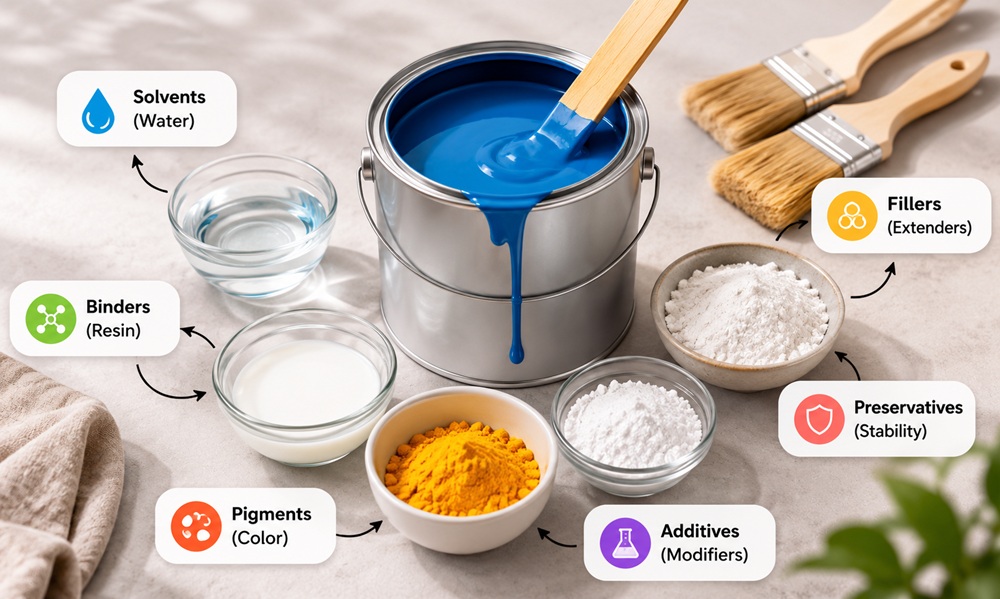

Paint relies on several key elements and compounds, most notably titanium (as titanium dioxide) for white pigment and opacity, iron (as iron oxide) for red, yellow, and brown tones, and zinc (as zinc oxide) for durability and mildew resistance. These are combined with binders, solvents, and additives to create the finished product you buy in a can.
Most people never think about what’s actually in paint beyond the color on the swatch. Understanding the basic chemistry helps explain why some paints cover better, last longer, or cost more than others.
The Problem: Paint Looks Simple But Isn’t
A can of paint looks like a single uniform liquid, but it’s actually a carefully balanced mixture of pigments, binders, solvents, and additives, each contributing something specific to how the paint applies, dries, and holds up over time. The elements and compounds used in the pigment portion are what most people are curious about when they ask what paint is “made of.”
Solution: The Core Elements Behind Paint Pigments
Titanium dioxide is the most widely used white pigment in modern paint, prized for its exceptional opacity and brightness. It’s responsible for the “hiding power” of paint, meaning how well one coat covers whatever color was underneath. Most white and light-colored paints rely heavily on titanium dioxide as their base pigment.
Iron oxide compounds produce a range of natural earth tones, from deep reds and browns to warm yellows. These are some of the oldest pigments used in paint, dating back to prehistoric cave paintings, and remain common today because they’re stable, non-toxic, and relatively inexpensive to produce.
Zinc oxide serves a somewhat different role than color pigments. It’s added to some paints for its mildew-resistant properties and to improve durability, particularly in exterior paints exposed to moisture.
Carbon, in the form of carbon black, is used to create black pigments and to darken other colors. It’s one of the most stable pigments available, resistant to fading from UV exposure.
Why Does Paint Need Pigment Elements?
Pigments are what give paint its color and opacity, but they also affect how the paint performs over time. Pigments with poor lightfastness fade when exposed to sunlight, which is why higher-quality paints often use more stable pigment compounds like titanium dioxide and iron oxide rather than cheaper, less stable colorants.
Local Insights: Old Paint and Lead Concerns
Homes built before 1978 in the United States may still have layers of old lead-based paint underneath newer coats. Lead was historically used as a pigment and drying agent in paint until it was banned for residential use due to serious health risks, particularly for children. If you’re renovating an older home and suspect lead paint, testing before sanding or scraping is strongly recommended, since disturbing lead paint can release harmful dust into the air.
Beyond Pigments: What Else Is in Paint
Binders, often acrylic or latex polymers in modern water-based paints, hold the pigment particles together and help the paint adhere to surfaces as it dries. Solvents, either water in latex paints or petroleum-based liquids in oil paints, keep the paint in a liquid state until application and then evaporate as the paint cures.
Additives round out the formula, including thickeners for consistency, preservatives to prevent mold growth in the can, and UV stabilizers to help exterior paints resist fading.
Natural vs Synthetic Pigments
Natural pigments, like iron oxide and certain clay-based colorants, have been used for thousands of years and remain popular in specialty and eco-conscious paint lines. Synthetic pigments, developed more recently through chemical processes, often provide more vibrant and consistent colors, along with reliable batch-to-batch matching that’s harder to achieve with natural mineral sources.
What Is Titanium Dioxide’s Role in Paint?
Titanium dioxide functions as both a pigment and a functional additive, providing the bright white base most paints start from while also improving durability and resistance to yellowing over time. Its high refractive index, meaning how effectively it scatters light, is what gives paint its strong hiding power, allowing fewer coats to fully cover a surface.
Understanding these basic elements doesn’t just satisfy curiosity, it can also help you choose better paint for specific projects, since higher pigment quality generally correlates with better coverage, color retention, and overall paint performance.
How Pigment Quality Affects Price
Higher-end paints generally use more titanium dioxide and higher-quality pigment dispersions, which is a major reason premium paint brands cost more per gallon than budget alternatives. Cheaper paints often substitute a portion of titanium dioxide with less expensive filler materials like calcium carbonate, which reduces cost but also reduces hiding power, meaning you may need additional coats to achieve the same coverage. This tradeoff is worth considering when comparing paint prices, since a cheaper can that requires three coats may end up costing more in time and materials than a pricier paint that covers fully in two.
Why Some Paints Yellow Over Time
Certain binders and pigments are more prone to yellowing with age and UV exposure than others. Oil-based paints, in particular, tend to yellow faster than modern acrylic latex formulas, largely due to the chemical breakdown of the oil binder over time rather than the pigments themselves. This is one of several reasons latex paint has become the dominant choice for interior walls, since it maintains its original color more reliably over the years compared to older oil-based formulas.
A Simple Takeaway for DIY Painters
Next time you’re comparing paint cans at the store, checking whether a product lists titanium dioxide prominently among its ingredients, or simply comparing hiding power ratings on the label, can give you a rough sense of quality beyond just the price tag or marketing claims on the front of the can.