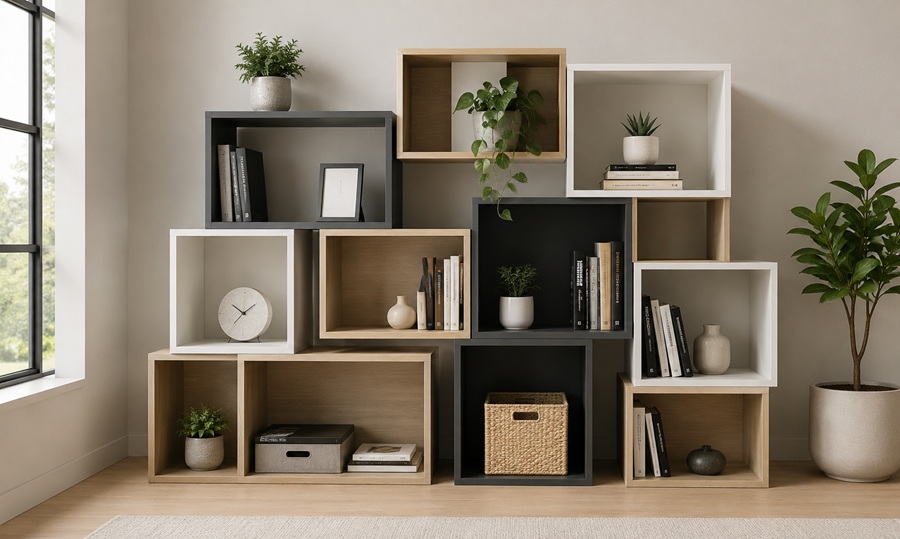

Modular shelving units are storage pieces built from repeatable components — cubes, panels, or bays — that connect together and can be added to over time. A unit that starts as a single 3×3 cube grid can expand into a full wall system without replacing the original pieces, which is the core advantage over a fixed shelving unit. Most buyers start with a $100 to $300 base configuration and expand from there.
Planning a modular shelving system works best as a step-by-step process rather than picking a product off a listing photo. Here’s how to source, compare, and configure one that actually fits your space.
What Makes a Shelving Unit “Modular”?
The defining feature is that individual sections can be purchased, added, removed, or rearranged independently. A modular unit typically uses connector hardware, stacking pins, or a shared track system so that new modules physically match the ones you already own. This matters most for anyone who expects their storage needs to change: a home office that might become a nursery, a garage where tool storage needs grow every year, or a rental where furniture needs to break down and move easily.
Common Use Cases
- Living rooms — media storage combined with book and decor display
- Closets — customizable bins and shelves that adjust to clothing, shoes, and accessories
- Garages — heavy-duty metal bays for tools, seasonal items, and storage bins
- Home offices — mixed open and closed storage for files, supplies, and equipment
- Kids’ rooms — stackable cube units that can be reconfigured as a child grows
Where and How These Systems Are Typically Sourced
Most buyers in the US either purchase pre-made modular kits from furniture retailers, where matching expansion pieces are sold separately, or work with a closet or garage storage company that custom-configures a modular layout during an in-home consultation. Big-box and online furniture retailers tend to be the more affordable route for straightforward setups like cube storage or ladder shelving, while custom installers are better suited for irregular spaces, garages needing heavy-duty capacity, or closets with unusual dimensions.
Before ordering online, check whether the manufacturer has a track record of keeping matching pieces in stock. Buying into a system that gets discontinued a year later can leave you stuck without matching expansion options.
Comparing the Main Configurations
Cube storage units. Square modules that connect side by side and stack vertically. Best for lighter items, decor, and closed storage using fabric bins. Typically the most affordable modular option.
Ladder-style shelving. Leaning frames that rest against a wall at an angle. Good for renters since most styles don’t require wall mounting, though anti-tip strapping is still recommended for anything over four feet tall.
Track-mounted shelving. Vertical tracks anchored into wall studs, with adjustable brackets. The most flexible option for changing shelf height without new hardware, and a strong choice for rooms where storage needs shift often, like a pantry or home office.
Freestanding bay systems. Larger frame units, often metal, that bolt together horizontally to expand capacity. Common in garages and basements where weight capacity matters more than aesthetics.
Expert Advice: Planning Your Layout
Start with an honest inventory of what you’re storing, since weight and item type determine which configuration makes sense. Books and decor suit lighter cube or ladder systems; tools and bulk storage need freestanding bay systems rated for heavier loads.
Measure your space in three dimensions — width, height, and depth — and account for door swings, light switches, and outlets that might interfere with placement. A common planning mistake is measuring wall width but forgetting ceiling height, which matters if you’re stacking cube units vertically.
For weight capacity, check the manufacturer’s rating per shelf, not just the unit’s total capacity. A shelf rated for 30 pounds can look identical to one rated for 75 pounds, and loading it beyond that rating leads to sagging or failure over time.
Room-Specific Configuration Notes
Garage. Prioritize freestanding bay systems with metal frames, since garages typically store heavier and bulkier items than any other room. Anchor tall units to wall studs even in freestanding-rated systems.
Closet. Track-mounted or cube systems work well, since closets benefit most from height-adjustable shelving that can shift as clothing and storage needs change across seasons.
Living room. A mixed cube system — some open sections for display, some closed for hidden storage — tends to fit a living room’s dual role as both a functional and a visible space.
How Do Modular Shelving Units Work?
Modular shelving units connect through shared hardware — pins, clips, brackets, or a mounted track — that lets individual sections attach to one another or to the wall. Because each section uses the same connection system, new modules can be added later without replacing the original pieces, which is what separates modular shelving from a traditional fixed bookcase or cabinet.
Frequently Asked Questions
Can modular shelving units support heavy items like tools or electronics?
It depends on the system. Metal freestanding bay units are built for heavier loads, often rated well above what cube or ladder systems can hold. Always check the per-shelf weight rating rather than assuming based on the unit’s overall size.
Do modular shelving systems work in rented apartments?
Ladder-style and freestanding cube systems are generally renter-friendly since most don’t require permanent wall mounting, though anti-tip strapping into a stud is still recommended for taller units for safety.
How do I know if a modular system will still have matching pieces available later?
Check the manufacturer’s product history and reviews for how long their lines typically stay in production. Established furniture brands with ongoing product lines are a safer bet than newer or limited-run collections.
What’s the difference between modular shelving and built-in shelving?
Modular shelving is freestanding or wall-anchored but not permanently part of the wall structure, meaning it can be reconfigured or removed. Built-in shelving is constructed as a permanent part of the room and can’t be rearranged without renovation work.